ADVERTISEMENT

September 28, 2020
Iron ore—has been the best preforming mineral in 2020. Revealed here are the top 3 junior mining companies positioned to ride the iron wave to profits.
Make no mistake, gold has done quite nicely this year, rising to record highs, as investors scramble to protect themselves against central banks flooding the world with cash.
But if you want to look at a truly unexpectedly eye-popping chart, take a look at iron ore in 2020. Prices have surged more than 35% so far this year—hitting prices over $120 per ton, the highest levels since 2014.1
Even though those numbers are impressive, they’re only a taste of what can happen when iron gets hot. For example:
From March 31, 2009 to March 31, 2010, iron ore soared from $64 to $184. That’s 187.5% in a single year.
From July 31 to December 31, 2012, iron ore rose from $96 to $153. That’s 59.4% in just 5 months.2
In other words, even at today’s levels, there’s plenty of upside still left for investors. At the bottom of this article we reveal the 3 top junior mining companies who are positioned for substantial growth.
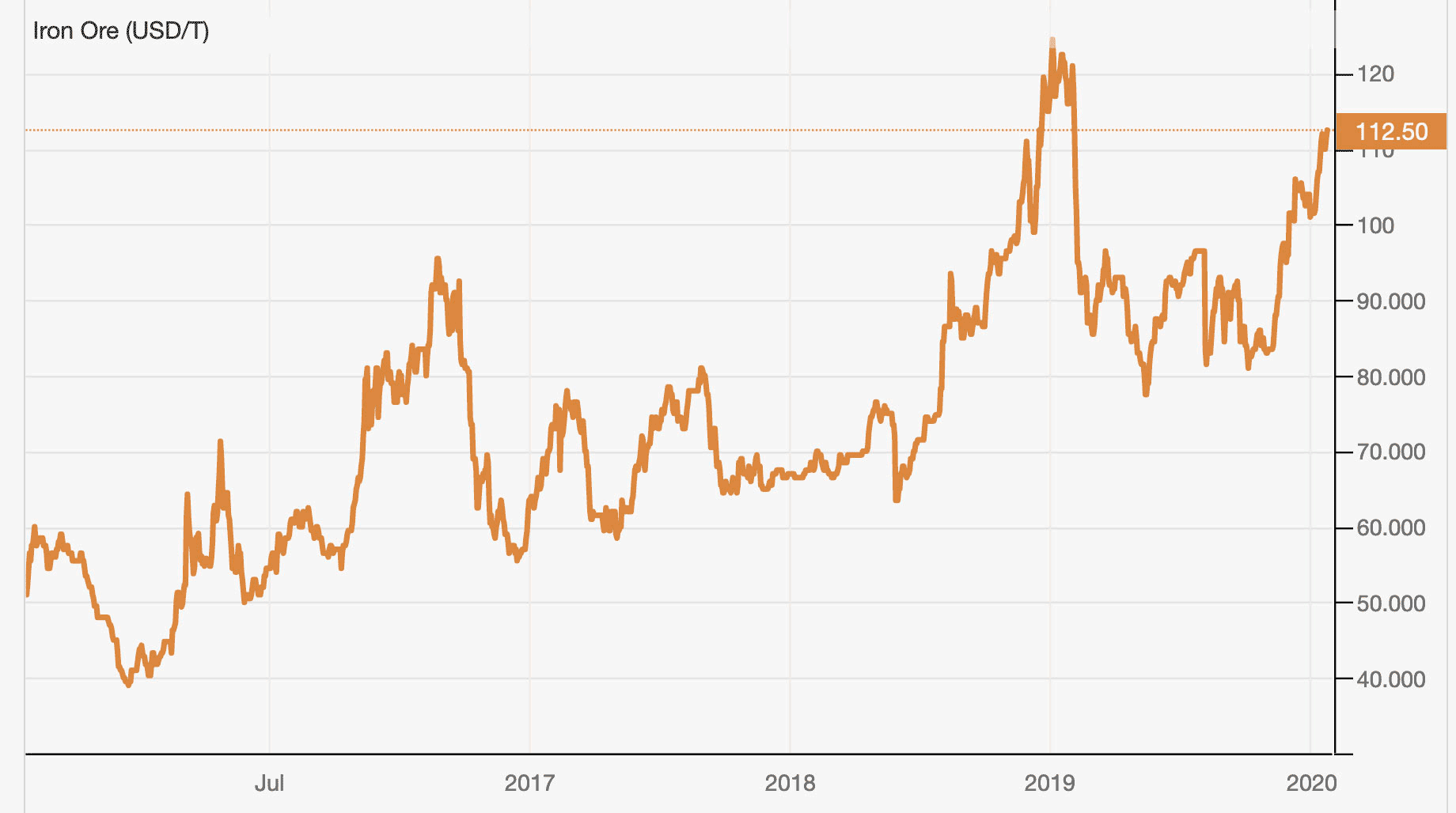
What’s behind the surge? As the world recovers from slowdowns and shutdowns, numerous nations are initiating major infrastructure projects to restart their economic engines. As the prime component of steelmaking, that’s been driving demand for iron ore. Simultaneously, virus-driven challenges in the mining industry have made the supply of raw materials harder to come by.
For several years, China has been the world’s largest importer of iron ore, with the numbers running about 1 billion metric tons annually.3 Although their demand dropped earlier this year, they were the first country to exit the coronavirus crisis—and shoved their way to the front of the line to grab as much iron as they could.
Of course, China isn’t the only one on a spending spree. The U.S. Congress is in discussions about $1.5 trillion in infrastructure investments over the next decade—destined for steel-intensive projects such as roads, bridges, waterways, energy projects, rural infrastructure, public lands and other ventures.4
Not to be outdone, European Union leaders recently agreed on a $2 trillion spending package.5
Add it all up, and it’s a classic supply–demand crunch—with no signs of stopping.
It’s a reminder of the iron-clad rule that there’s money to be made whenever governments are throwing around cash—but you need to find the right way to grab your share.
Unlike gold, obviously, iron ore isn’t something you can store in your closet safe. You need to find and leverage the miners who are profiting from the economic drivers.
Iron Ore mining companies have long been among the biggest, most profitable trades an investor can make—although the timing is as critical as the metals that are being harvested from the ground. In a moment, we’ll share our top 3 junior mining growth opportunities, but let’s start by discussing some of the most familiar names in iron ore and industrial metals: a glimpse of the possible future for the juniors who hit the big time.
Diversified Anglo-Australian mining company Rio Tinto produced 327 million tonnes of iron ore in 2019. In terms of market capitalization, Rio Tinto is bested only by BHP Group, worth $88.6 billion on the New York Stock Exchange (NYSE).
Next among the big 3 is Vale, formerly known as Companhia Vale do Rio Doce and headquartered in Rio de Janeiro, Brazil. A diversified multinational and mining company that also has a significant logistics business, Vale has a market capitalization of $61.7 billion on the NYSE.
These three established producers are the 800-pound gorillas in the iron ore space. As successful veterans of the mining sector, they have put in decades of development—and are trading at very high prices with impressive market caps as a result. For long-term, buy-and-hold investors who prefer modest gains and low risk, they can be a solid pick. For those of you who have a higher risk/reward ratio in your portfolios, our top three junior miners are positioned to generate significant interest from the Investment community.
Imagine for a moment that you were one of the first investors to take positions in any of the mining majors mentioned above. Safe to say, those are the types of situations investors dream about—and if you could turn back the clock, knowing what you know today, you wouldn’t hesitate to go all-in. At The Growth Equity Report, we’ve made it our mission to find just those types of trends in any given industry—then do the extensive research to uncover the next big growth situation for investors to reap the benefits.
As we’ve scoured the mineral markets, looking for the next potential Rio Tinto, BHP, or Vale, here are the top 3 international junior mining companies we believe represent the best opportunities for investors today in their respective regions.
#1. Temas Resources Corp., headquartered in Vancouver, Canada, has emerged as the leading development stage company with significant property holdings in Quebec—one of the most mineral-rich areas in North America. Tapping into a red-hot iron market, plus titanium and vanadium, makes this company a rare triple threat—according to the NI 43-101 Technical Report previously filed, they have abundant high-quality showings of all three minerals on their properties. It’s important to note that Temas’s properties are in the same geographic location as mining major Rio Tinto’s very successful Canadian iron and titanium mines. Temas Resources Corp. currently has a $17.5 million market cap, and they recently started trading as a public company on the Canadian Securities Exchange (CSE) in Canada and the OTCQB in the United States.
#2. Based in Australia, Strike Resources is a resource company focused on the development of projects including iron ore and battery minerals in Australia and South America. Since 2005, Strike’s most notable operation has been the Apurimac Iron Ore Project in Peru, recognized as one of the highest-grade large-scale magnetite projects in the world. Strike Resources has a market cap of $24.9 million AUD and trades on the Australian Stock Exchange (ASX).
#3. Finally, we have Zanaga Iron Ore Company Limited, an iron ore exploration and development company incorporated in the British Virgin Islands. This junior’s flagship asset is its 50% less one share interest in the Zanaga Iron Ore Project, which is located in the Republic of Congo. (Mining major Glencore plc is the majority owner, with 50% plus one share interest and effective management control of project.) Zanaga is listed on the AIM, a sub-market of the London Stock Exchange (LSE), and has a market cap of £17.7 million GBP. Note that their share prices have recently pulled back; although it could be considered a decent entry point at today’s levels, the early-in prices and initial run are long over—hence its position as our third-place pick.
*We have created this list in order of best entry levels, shares outstanding, management, geographic locations, proven or historical mineral showings and overall project highlights/facts. Investors take note: With iron markets and specialty mineral markets getting stronger with every passing day, any new findings or positive corporate development could send the shares on an upward trend very quickly—so there’s no better time to start doing your due diligence.

Receive our updates right into your inbox!
As simple as filling out this short form below.
NEW MEMBER GIFT!
Receive our free PDF presentation about how to capitalize on the Iron Surge!

You can unsubscribe anytime.
Share this article