ADVERTISEMENT

If you’re not in yet, here’s what you absolutely need to know.
September 28, 2020
Something big is brewing in the investment community
If you’re dialed into the market buzz, it’s possible you’ve heard about it. If you have the right networking connections, you might have been asked if you’re in already. So…what is it?
You’ve come to the right place. In the next few minutes, we’ll break it down for you—and more important, you’ll learn exactly how to capitalize on it. You see, every once in a while, there comes a situation, an opportunity that lies ahead of a tremendous shift in the market landscape.
For example, you may remember hearing about the “BANG Trade” in gold during the past few years. Sure enough, the top 4 gold mining stocks whose initials create the BANG acronym—Barrick Gold, Agnico Eagle, Newmont Mining and Goldcorp—have been on an absolute tear, particularly since the lows in March.
Or maybe you recall the “Wheaton Windfall,” named after Wheaton Precious Metals’, rising from $3.45 in 2008 to $43.36 in 2011 for a 1156.8% gain over 3 years, thanks to a clever business model that invested in the production of other silver mining companies as well as their own mining. Again, it changed the landscape.
Today, similar excitement is building around other resources. Like any market shift, there are risks, but the potential for making a multi-industry impact is downright astonishing.
The Key to this investment Play:
Rich Source of 3 Critical Minerals in Canada’s Top Mining Region.
Rich Source of 3 Critical Minerals in Canada’s Top Mining Region.
KEY FACTS
Rich Source of 3 Critical Minerals in Canada’s Top Mining Region
Rising Prices, Growing Global Demand and Supply Shortages in Iron Ore
Vanadium Provides Mining Solutions to Technology Problems
Titanium, the Swiss Army Knife of Metallic Elements
The mining sector has a long history here in Canada’s most mining-friendly province, with dozens of mines and exploration projects driving nearly $1 billion a year in revenues from rich metal and mineral deposits. Not only does the Quebec infrastructure cater to mining—with extensive rail and seaport access, cheap power and plentiful water—the region attracts a world-class talent pool and elite miners such as Rio Tinto, ArcelorMittal, and Glencore.
Even so, this investment Play represents an under the radar trend that could absolutely blow away anything that this area has seen before.
As an investor, this trend might remind you of the concept of the pick-and-shovel principle from the old days of the California Gold Rush: There’s money to be made in selling the tools rather than the final product of a given enterprise. Taken literally, the “surest thing” in the 1800s Wild West came from selling picks and shovels to prospectors digging holes in the mountains.
In the modern mining industry, strategic thinking about resource plays has taken on additional dimensions: Success isn’t just about the value of the raw materials dug from the earth, but the long-term prospects of the industry that they are destined for. Get ahead of a global trend, and you can ensure the profitable extraction and economic viability of your metals and minerals.
That’s the key to this investment Play…and there are 3 major reasons why you can’t afford to be left behind.
Keep reading!We reveal the best growth opportunities for investors in this sector below

Reason #1:
Supply Shortages in Iron Ore… and Rising Global Demand.
Supply Shortages in Iron Ore… and Rising Global Demand.
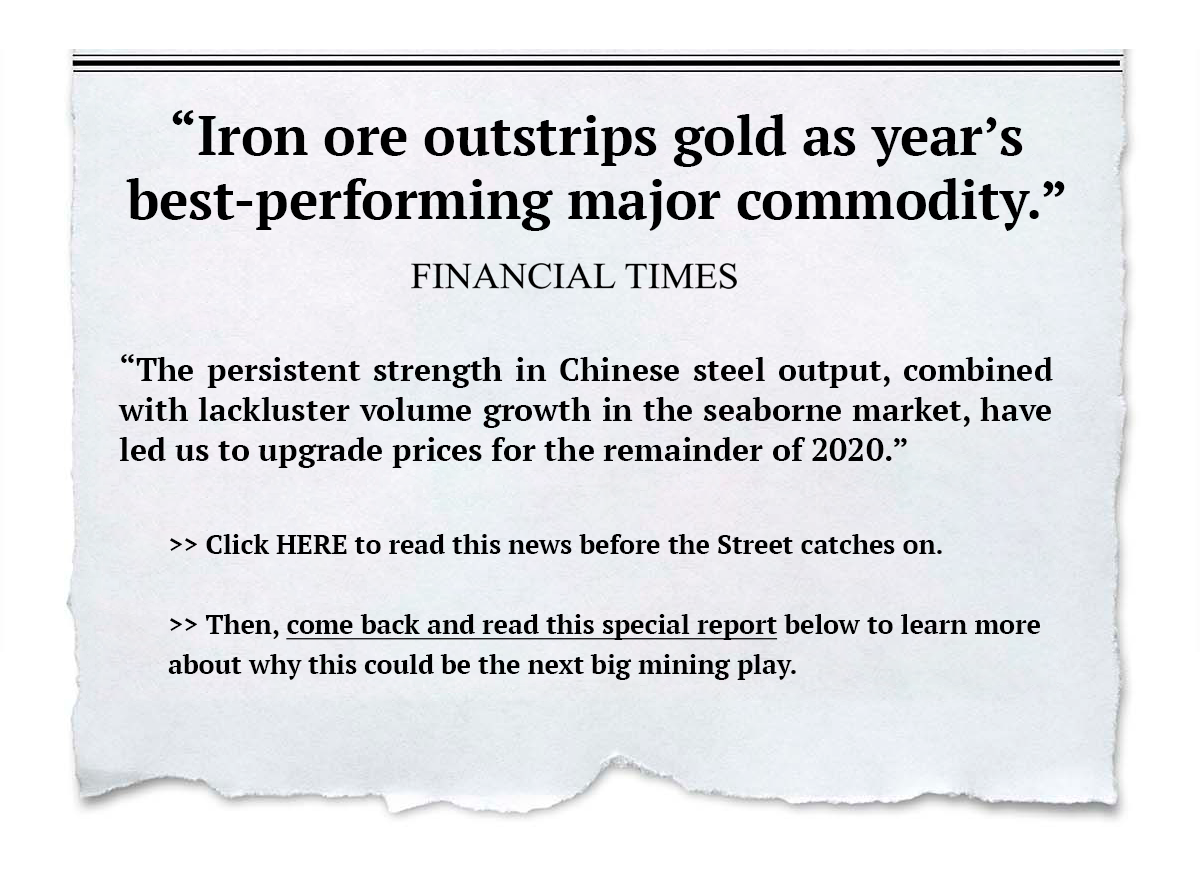
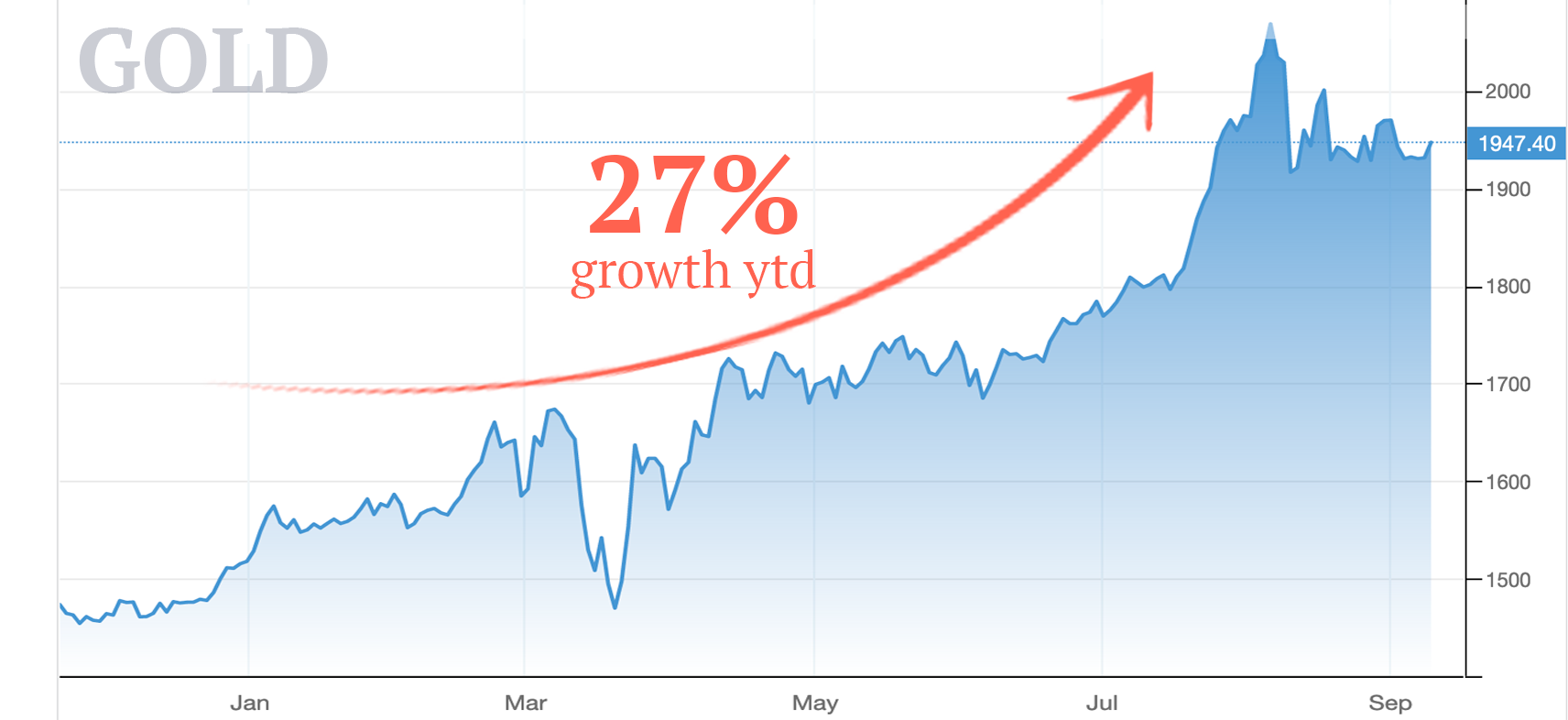
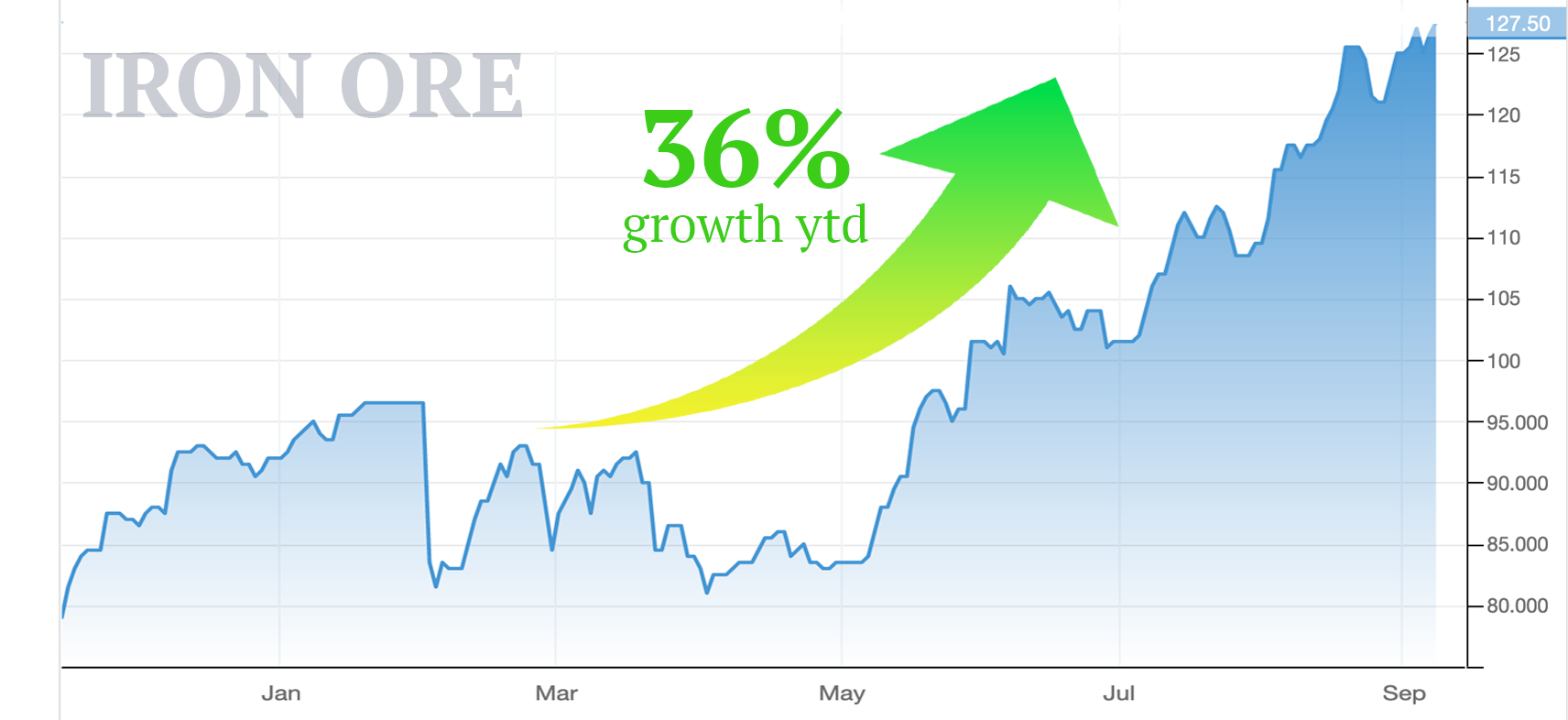
The first angle is the well-known global market in Iron Ore, which has been a standout performer in recent months. Iron rose from $93.56 in January 2020 to a peak of $127.53, for a 36% gain. For perspective, compare that performance to gold’s results: a 27% gain from January 2020 at $1519.50 to the recent $1930.1
Why is Iron Ore surging? It’s a classic supply–demand setup. Production has fallen off in recent months, while a recovering global economy—particularly China, back at full steam—needs plenty of steel for infrastructure and other industrial demands.
When the global economy is firing on all cylinders, you won’t find a more stable and profitable sector.
The U.S., for example, is on the verge of a $1 trillion infrastructure proposal to reboot the economy and job sector. Iron Ore is always going to be in demand, but the next few years could be a significant boom. “Iron ore and coking coal should be most resilient due to their weighting towards China, infrastructure, and high-rise multi-year property builds, where construction should continue,” Credit Suisse recently said in their Commodity Notes publication.
Reason #2:
Titanium, the Swiss Army Knife of Metallic Elements.
Titanium, the Swiss Army Knife of Metallic Elements.
Second, the Quebec region has a long history of mining Titanium—a highly corrosion-resistant metal that also has the highest strength-to-density ratio of any metallic element. Titanium’s most outstanding attribute is its diversity of uses. The majority of titanium ore is refined into titanium dioxide, which is used as a pigment in paints and coatings, paper, toothpaste, plastics, and cement. Experts project the global titanium dioxide market will expand to more than $28 billion by 2025, representing a healthy 8.7% CAGR.2
Mixed with iron, aluminum, vanadium, or molybdenum, Titanium is also used for the production of strong, lightweight alloys for aerospace, military, and automotive, among many other industrial processes. Its lightweight strength also offers significant utility in the medical world, for use in prostheses, implants, and instruments. Finally, you surely have some Titanium with arm’s reach, as it’s a popular component in sporting goods, jewelry, and electronics, and personal care products, among many other uses.
Like Iron Ore, Titanium stands to benefit from a recovering world economy, as demand rises for the many industrial and consumer products that require it.
Reason #3:
Vanadium Provides Mining Solutions to Technology Problems.
Vanadium Provides Mining Solutions to Technology Problems.
Third, we have the metal Vanadium, which has been causing a buzz in the markets recently. An element discovered first in the early 19th century, Vanadium finally gained large-scale industrial utility at start of the 1900s, when it was used to reduce the weight and increase the strength of steel in Model T Fords. In subsequent decades, it has been incorporated into many uses of metal alloys, from surgical tools and dental implants to jet engines and airframes.
Now, it’s a signal of why this resource Play needs to be on your investment radar.
As it turns out, Vanadium isn’t merely exceptional at strengthening metal: Its unique properties make it perfectly suited for use in two forms of rechargeable batteries—both of which could lead their respective electric battery sectors in the near futures.
The first has been around for a few years, in the form of so-called Vanadium redox batteries that are used commercially for grid energy storage. As a way to store energy for renewable electricity generation from wind or solar, they offer benefits in efficiency and cost vs. lithium-based batteries.
Even more exciting, however, is Vanadium’s potential for revolutionizing the electric vehicle battery industry, which is anticipated to be worth $84 billion by 2025. In layman’s terms, Vanadium is able to improve the performance of lithium batteries, achieving faster recharging, better storage, and more power. This isn’t just a pie-in-the-sky dream either—an Audi A2 powered by a lithium-Vanadium battery recently set a long distance record, and companies such as Subaru, BYD Auto (a Chinese electric car manufacturer backed by Warren Buffett), and Valence Technologies have fast-tracked research and development work to scale the technology to a wider audience.
Quebec’s Advantage for Mining Iron Ore, Vanadium, and Titanium.
Whenever doing due diligence on mining companies in a global environment, it’s obvious to seriously examine a given country’s suitability for and support of mining. Balancing terrain and infrastructure, labor quality, work conditions, and even political stability are part of the decision-making process.
The appeal of Canada can’t be surpassed in those respects. Natural resource-rich Canada ranks in the world’s top five producing countries for 13 major minerals and metals; in 2016, approximately 200 mines and 7,000 quarries produced more than 60 minerals and metals worth $41 billion.
Zooming in on Quebec, you have the most diversified mining industry in the country, including products such as Iron Ore, Titanium, gold, and diamonds—and of course, Vanadium. In 2018, the province was named the Fraser Institute’s fourth most attractive destination for mining investment in the world. An extensive rail system, deep-water seaports, easily accessible power, and a skilled talent base in mining all contribute to the mix.
Note that the advantage of mining Iron Ore, Titanium, Vanadium and other metals in Quebec is particularly relevant in the current global economic environment. Uncertainties caused by the U.S.-China trade war and global supply issues could play right into Quebec’s hands.
Keep reading!We reveal the best growth opportunities for investors in this sector below
Key Companies Mining Iron Ore and Vanadium.
The miners focused in the Iron Ore and Vanadium space include some familiar names, but quite a few that may not be on your radar.
The big player is Rio Tinto, which ranks as the world’s third largest mining company—and it also happens to be the second-largest producer of Iron Ore and a leader in Titanium as well. Second-tier players include First Vanadium, which is focused on a Vanadium project located in Nevada; Largo Resources, which splits its efforts between Brazil and Canada. The fact is though, that these companies are still relatively well known and thus the biggest gains have already been made by early investors—there aren’t a lot of secrets behind the scenes that savvy investors can capitalize on.
Opportunity knocks for investors
In contrast, there is an early-entry, below-the-radar company in the region that has recently just gone public in Canada and the United States, they recently acquired 100% ownership in 2 mineral properties in Côte-Nord, the same region where Rio Tinto also operates mines with similar geological formations. According to a NI 43-101 Technical Report, they could be tapping into a substantial Vanadium deposit.
In addition to Vanadium, the DAB and La Blache mineral-rich properties offer two other industrial metals that diversify the companies’ portfolio: Iron Ore, in high-quality direct-ship grade, and Titanium, which Rio Tinto has been mining successfully in Quebec since the 1940s.
Having a mix of metals gives this company an advantage of being able to smooth out peaks and valleys, when a given sector heats up or cools down. Equally important, the company’s aggressive strategic plan positions them to consolidate a variety of key mineral assets in the Côte-Nord region, opening up opportunities for mergers, acquisitions, and partnerships.
As history proves, investors who get in on promising companies in their infancy are the ones with the best opportunity to capture massive profits—and there are indications that this company could be getting a lot of positive notice in the near future. We reveal the company details below!
What Could Be Next for Vanadium Batteries…and Miners?
If you want to see how fast and hard Vanadium stocks could rise, you don’t have to look too far back in history. In 2018, some of the star performers were up 100% to 500% or more—including Largo Resources, which soared 285% and First Vanadium, which rose a whopping 616%.3 While past results are no guarantee of future performance, positive news in the Vanadium battery industry could easily spark a new round of fast moving prices.
Additional fuel could come in the form of a new technological advance in applying Vanadium…or it could be the announcement of a new auto manufacturer choosing a Vanadium solution for its battery-powered vehicles…
On the Iron Ore side, it might be the announcement of new stimulus packages in the U.S., Asia-Pacific, or E.U., with governments pouring money into infrastructure projects.
Similarly, Titaniumcould be more in demand due to a recovering global economy and need for industrial materials…or a breakthrough in 3-D metal printing.
It could even be a rumor that a mining major has a junior explorer in its sights.
It could even be a rumor that a mining major has a junior explorer in its sights.
In the early innings, our number one selected mining investment is certainly worth a look as you’re doing your due diligence on potential investments—and particularly those taking an inside line on the iron ore, titanium and vanadium trends. While money will be made by the battery manufacturers, it’s the Vanadium miners and suppliers who can sell to all of them that could be opening themselves to the most massive opportunity of all.
KEY FACTS
Rich Source of 3 Critical Minerals in Canada’s Top Mining Region
Rising Prices, Growing Global Demand and Supply Shortages in Iron Ore
Vanadium Provides Mining Solutions to Technology Problems
Titanium, the Swiss Army Knife of Metallic Elements

Receive our updates right into your inbox!
As simple as filling out this short form below.
NEW MEMBER GIFT!
Receive our free PDF presentation about how to capitalize on the Iron Surge!
You can unsubscribe anytime.
Share this article