
Better Than Gold? This Overlooked Resource is Outperforming…
We all know what happened with the global economy in 2020—and now it’s time to start thinking about what the recovery will look like. The fact is that the world’s major diversified miners entered the current crisis with their balance sheets in better financial shape than they were prior to the Recession of 2008-2009.1 Even with soft demand and on-the-ground challenges now, the inevitable recovery will benefit not only from those strong fundamentals, but the tailwind of significant stimulus packages in all the world’s major economies.
As investors, we’re taught to diversify our holdings. The fact is, the same principle applies to companies themselves. Diversity allows a company to be nimble during changing markets—and more important, to capitalize on opportunities when they are most profitable. That’s precisely the approach that the focus of this report, Temas Resources Corp. (CSE: TMAS – OTCQB: TMASF), is taking within the resource sector. Their DAB and La Blache properties in Quebec’s Côte-Nord mining region represent a potential triple play, with three key industrial metals with interesting grades and tenors.
As a result, Temas Resources has positioned themselves at the nexus of several major shifts in the global economy, including the electrification of transportation and the infrastructure to create and operate a smart grid. The market potential is significant, and the timing appears to be excellent. The performance of the BANG stocks—the four biggest names in precious metals mining, Barrick Gold, Agnico Eagle, Newmont Mining and Goldcorp—have had the hot hand since the lows in March. If history is a guide, other commodities and mining of specialty metals could potentially experience forward momentum as the world’s economies recover.
Gold has performed well this year, rising 27% into the $1900 range, thanks to stimulus spending by the world’s central banks and driving investors to safety. But savvy investors have noticed that a different commodity has outpaced gold’s results. Iron, the world’s key industrial material, has surged 36% in 2020, with no signs of stopping.
A number of factors have fueled the rise. First and foremost has been the recovery of the Chinese economy and a boost in funding for numerous infrastructure programs—resulting in record amounts of steel production, projected to be as much as 1 billion tons. Reading the tea leaves, investors have piled into the metal to get ahead of spending. The second factor is a supply crunch, due to mining disruptions in countries such as Brazil and Australia.


“Iron ore outstrips gold as year’s best-performing major commodity”
In its current 100%-owned mining properties–the company recently entered an agreement to acquire the 100% of LaBlache property–Temas Resources has access to three in-demand raw materials.
The first is iron ore, in which Canada ranks 8th in the world, with Quebec producing nearly two-thirds of the output.3 Iron ore is essential for the production of steel—in fact, that’s what 98% of it is used for, making it a critical component for construction, transportation, as well as countless other industrial and consumer uses.4 This market is particularly compelling right now, because a global supply shortage coincides with rapidly increasing demand—resulting in price increases to around $128 a ton, the highest levels since 2015. As we emerge from the economic downturn, China, the U.S., and other countries around the world have announced trillions of dollars in stimulus packages and infrastructure programs. You can expect them to drive demand even further.
The second is titanium, a high-strength lightweight metal used for a wide range of purposes, from paint pigment to joint replacements and sports equipment—and mixed with aluminum and vanadium for jet engines in aerospace and military defense uses. It’s a truism in the mining world, but looking at one’s neighbors speaks volumes: Note that the world’s third largest mining company Rio Tinto, with claims in the same area of the province, has proven the profitability of mining titanium in Quebec for about 70 years.
of the Quebec Mining Association
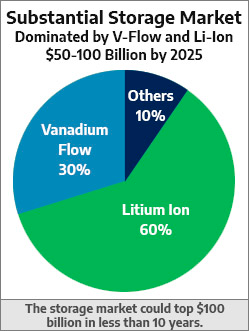
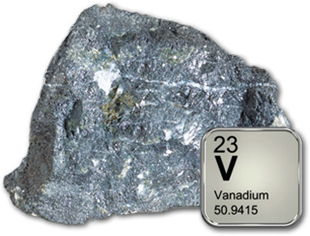
The third mineral is vanadium. While iron and titanium have steady industrial demand, vanadium has taken the pole position as a breakthrough ingredient for electric batteries.
First, vanadium grid-scale energy storage is an essential aspect of any intermittent energy source such as wind or solar, and has superior potential versus any current lithium-ion technology.
Second, what could be an even more significant game changer in the global electric car battery market (which could reach $84 billion by 2025)5, vanadium increases the performance of lithium ion batteries. Replacing cobalt oxide cathodes with vanadium disulfide increases storage capacity, power output, and recharging speed. Eventually, this could even have implications for consumer electronics and renewable energy power, but for now the key area of focus is electric vehicles—with intriguing examples such as an Audi A2 equipped with a lithium-vanadium battery that set a new long-distance record. Among the other companies doing R&D on lithium-vanadium-phosphate batteries and could soon put them into production include China’s BYD Auto, Japan’s Subaru Motors and GS Yuasa Corp. (which provides batteries for Mitsubishi Motors), and the United States’ Valence Technologies.6
Based on a 2020 NI 43-101 Technical Report, the Temas Resources claims are “likely to contain significant iron, titanium and vanadium oxide mineralizations of igneous origin and of economic interest.”7
Adds strength, toughness and heat resistance to steel alloys.
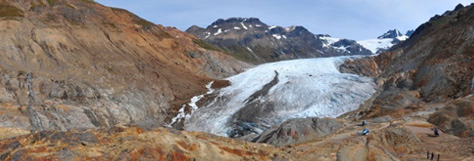
- 64.7% Iron(III) oxide (Fe2O3) – 2556ppm Vanadium (V) – 18.8% Titanium(IV) oxide (TiO2) at drill hole FM-11-01 (17.99m interval from 0.51m to 18.50m)
- 62.6% Iron(III) oxide (Fe2O3) – 1815ppm Vanadium (V) – 19.8% Titanium(IV) oxide (TiO2) at drill hole FM-11-07 (6.00m interval from 35.00m to 42.00m)
90% recovery of iron
95% recovery of high-purity vanadium
100% recovery of pigment-grade titanium dioxide
This is a region with a long history of mining, with many sites in various stages of development and production. The locations of the DAB and La Blache properties offer several advantages that leverage the mining-friendly province of Quebec. The surrounding area is uninhabited, with the nearest city being Baie-Comeau is about 150 km to the southeast, with railway service and a seaport to facilitate the transport of ore and other goods. Because the economic and industrial development in the region is largely based on natural resources, the infrastructure should represent significant savings for Temas on overall costs when it comes to the development stage of its assets.

It’s well-known that the Achilles’ heel of alternative energies such as wind and solar is that they’re intermittent—only generating power when conditions permit, and leaving fossil fuels to pick up the slack when they aren’t. Grid battery storage remains a difficult problem anywhere green energy is used.
Similarly, the potential of electric cars has been constantly hindered by poor battery life and slow charging—limiting their utility for anything other than short trips within metro areas.
Vanadium is on the verge of solving both issues. In layman’s terms, vanadium redox battery technology exploits vanadium ions in four different oxidation states to store chemical potential energy—creating an emerging solution for grid energy storage.
In car batteries, vanadium is looking like the miracle solution—turbo-boosting lithium ion batteries so that they charge faster, hold more power, and last longer.
In the second half of 2018, the market showed how vanadium stocks could soar—for example, Largo Resources jumped 285% while First Vanadium skyrocketed a whopping 616%. Rather than guessing which manufacturer will win the battery race, savvy mining investors know the real value will be tapped by the company that supplies vanadium battery companies with vital raw materials. 8

In the mining world, experience is everything, and Temas has assembled a highly experienced, goal-oriented management team that has proven ability to take a project from exploration all the way to a producing mine. With solid roots in a wide range of resource and mining sectors, key members include:
Kyler is a lifelong resources entrepreneur with the magic touch and significant experience in capital raising, corporate development, and corporate strategy. He got his start in the field—logging, diamond drilling, and working offshore oil rigs—before building several small and midsize exploration management firms, literally taking small placer gold mines from prospecting through development and into production. In addition to serving as CEO of Cronin Group, a Vancouver-based natural resource-focused merchant bank, he has served as CEO of Linceo Media Group, CEO of Imperial X Plc, and director of Hexa Resources and Prometheus Developments, among several others.
David is the CFO of Temas, and a standout star of the team on the accounting, capital markets, and investment analysis side of the business. His background includes providing tax, auditing, and consulting services to public and private enterprises, and a role as the CFO of the Cronin Group, a natural resource-focused merchant bank in Vancouver.
Michael boasts more than 25 years of capital markets and operations experience in the global natural resource sector, most notably as the CEO of Group Ten Metals and a director of Granite Creek Copper and Bravada Gold.
Konstantin brings more than a decade of accounting and capital markets experience to the Temas Resources team, including corporate finance, valuation, taxation and financial reporting, and working in private and public resource markets.
Because the two mineral properties are in different stages, Temas Resources will be taking a multi-faceted approach to bringing them to fruition.
An estimated 100 million tons of minerals are in the ground, according to the NI 43-101 Technical Report. According to management, next steps will include the continuation of detailed mapping, sampling, and prospecting of known and potential mineralized oxides occurrences. This would also include additional drilling to increase the knowledge base as well as potentially increase mineral resource and refine the geological model. With additional drilling and the revision of the geological model, an updated mineral resource estimation could include measured and indicated resource categories.
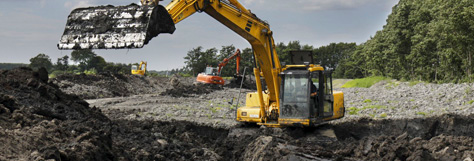
The company was attracted to La Blache because of the size and tenor of the deposit, and another advantage is that it is at the surface, making it amenable to open pit mining rather than underground. It is a bit of a unique opportunity in the fact that its grade and mineral composition make it attractive in various markets from base metal to specialty to battery metals. Additional metallurgical work needs to be done, but initial indications are that La Blache iron average grade is 41.76% and produces a desirable iron concentrate9.
Phase 1 is expected to include a high-resolution airborne magnetic survey to augment the previous survey, geophysical modeling and interpretation, and ground truth refined targets, possibly with an additional infill ground magnetic survey. Phase 2 would include additional drilling at the Farrell-Mason showing and exploration drilling at modeled targets.
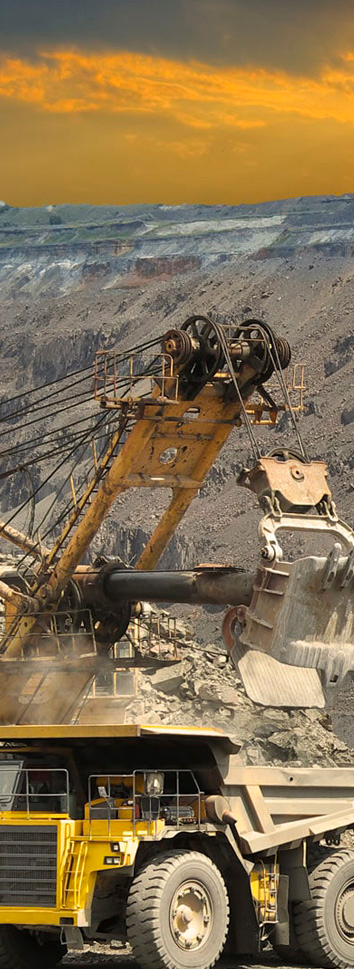
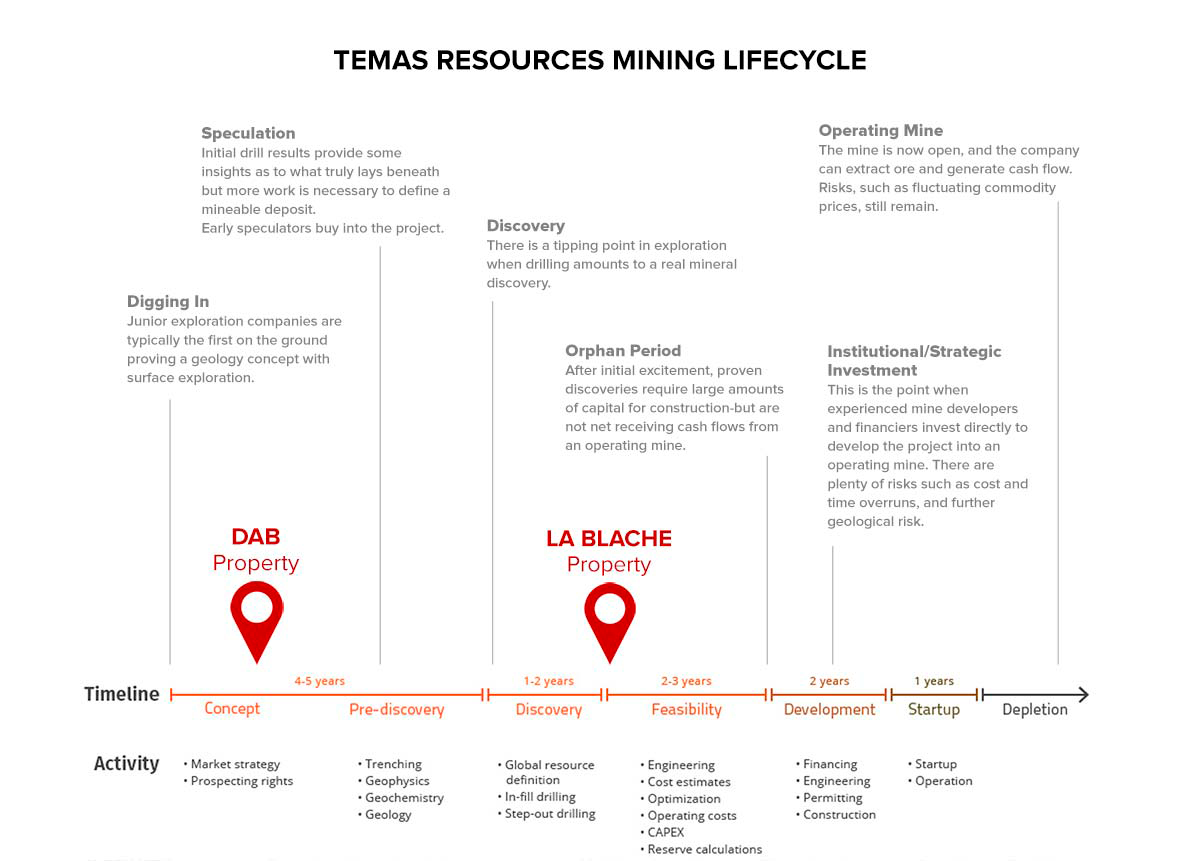
In particular, the company sees potential in several large northeast trending geologic trends interpreted off of government airborne geophysics data that have not been drill tested—but correlate with similar geology in the region that have become producing deposits. The far northeast end of the mineralized trend, at the Farrell-Mason showing, there are a few initial drill holes that have only clipped mineralization of interest—but have left the potential open in all directions with significant potential for additional mineral discovery.
Temas Resources’ plan is to consolidate the property-scale known showings. While there are competitors, there will be significant opportunities to become partners or, potentially even acquirers as the situation unfolds. (Customarily, mining exploration companies de-risk a given project, then majors come in, buy them out, and invest the big dollars to build the mine.) If the feasibility studies and metallurgical recoveries are favourable, it would make sense that Temas Resources could be appealing for North America-focused mining majors—or even mining-focused private equity groups.
As a result, the bigger picture for Temas Resources includes a strategic mergers and acquisitions plan, focused on complementary properties in the same region, size, and scope of iron, titanium and vanadium. By leveraging existing data, the Temas Resources team can determine the viability of an asset by using its technical ability. The same large magnetic conductors running northeast–southwest that sparked their interest in the region and initial assets could ultimately become an opportunity to consolidate a much larger number of deposits in their portfolio.
With a trio of diversified resources, Temas Resources could be tapping into the trends that will endure during and after the economic recovery. Iron and titanium are stable markets with solid industrial demand—particularly given the stimulus dollars driving infrastructure improvements around the world. And as noted above, vanadium gives Temas exposure to a mineral with exciting potential for revolutionizing how we store alternative energy.
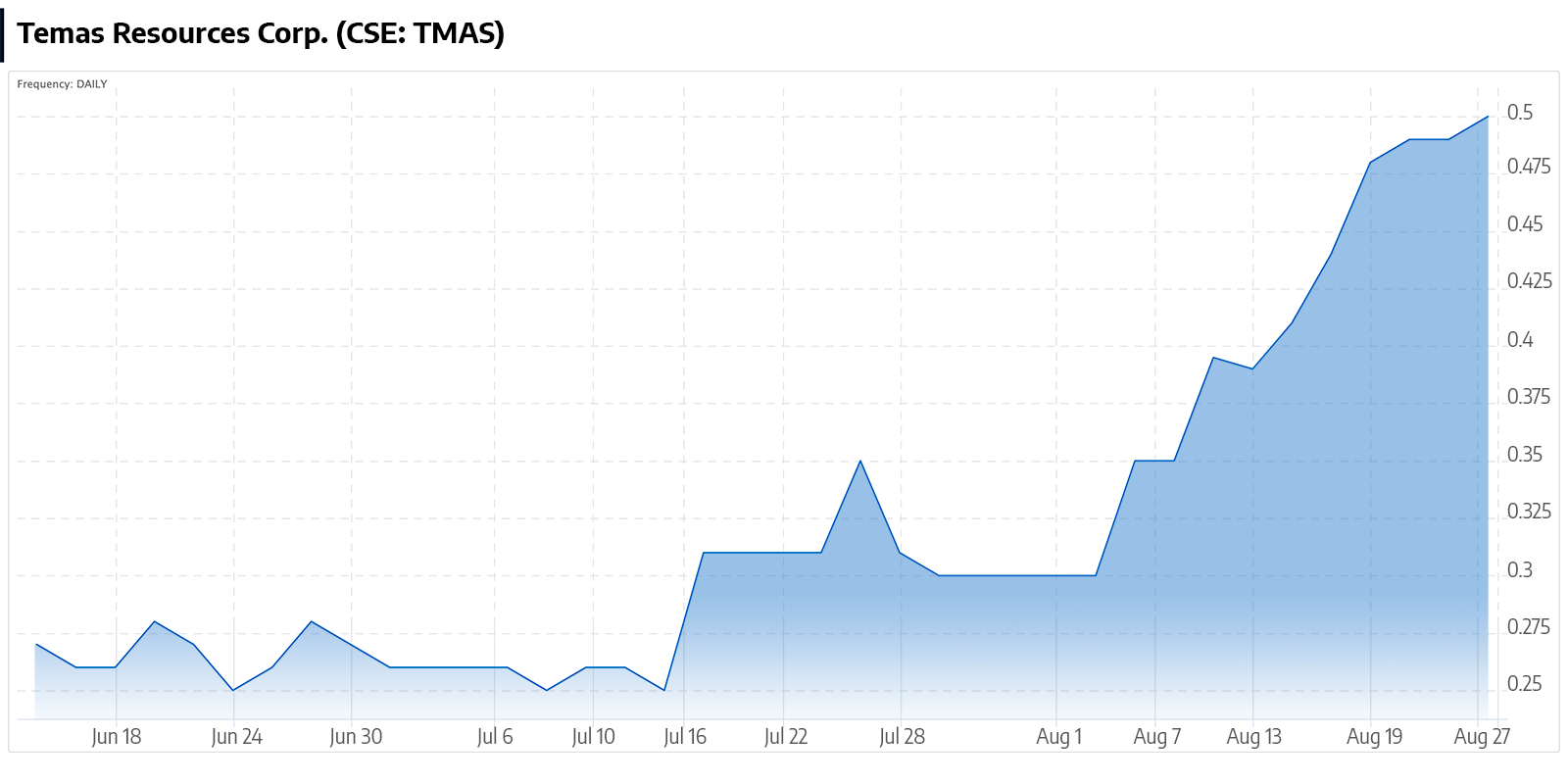
At this early stage, the company is playing their cards close to the vest as far as the potential company value. However, given that mining usually trades at several industry multiples, Temas Resources is clearly in an advantageous position as they execute on their strategic plans. There’s still a lot of development to do and money to raise, but the potential is there that the company could see a significant corporate increase in value. Temas Resources is publicly traded, with 36M shares outstanding.